Performance evaluation of concrete liners for high-temperature potash brine applications
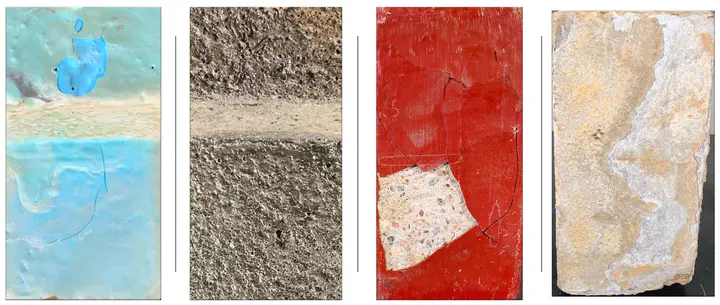
Engineering Services Delivered
In support of a potash mining corporation, we conducted a targeted evaluation of liner systems intended for reinforced concrete structures operating in challenging service environments. The objective was to determine the most effective protective lining solution to ensure long-term durability and structural integrity.
Commercial liners were applied to reinforced concrete specimens and subjected to prolonged exposure in a controlled environment simulating field conditions. The program was structured in two phases: an initial screening phase to evaluate candidate liner systems under simulated service exposure, followed by a detailed characterization phase focused on degradation mechanisms and barrier behaviour.
Phase 1 included specimen preparation, controlled brine exposure, visual inspection, resistance testing, hardness testing, and pull-off adhesion testing. The sequence progressed from non-destructive to destructive methods so severely damaged systems could be screened out early while stronger candidates received more detailed evaluation.
Phase 2 extended the methodology through scanning electron microscopy, SEM-EDS elemental analysis, optical profilometry, FTIR spectroscopy, Raman spectroscopy, and microscale chloride profiling. This combination of techniques enabled assessment of surface morphology, chemical modification, topographic evolution, and near-surface transport behaviour relevant to long-term liner durability.
This structured, multi-stage testing approach enabled the elimination of underperforming candidates and ensured the selection of the most suitable solution based on overall material performance and compatibility.
Core Outcomes
- Designed a two-phase evaluation program for liner systems exposed to simulated high-temperature potash brine conditions.
- Applied progressive screening methods including visual, electrical, mechanical, and adhesion-based testing on concrete-mounted liner specimens.
- Combined microscopic, spectroscopic, and transport-focused techniques to assess surface integrity, chemical change, and barrier behaviour.
- Generated a practical methodology for comparative evaluation of protective liner systems in aggressive industrial environments.
The work delivered a robust testing and characterization approach to support infrastructure protection strategies and liner assessment in corrosive brine service environments.

Gang Li
Research Associate
My research focuses on corrosion and durability of engineering materials and structures.